Old Soul, New Vision: How to Balance Traditional & Contemporary Wedding Decor
By Team Wedica | May 14, 2026
For most couples today, wedding decor isn’t a clean choice between old and new. It’s a negotiation between aesthetics, expectations, and the version of yourselves you want to celebrate on one of the most meaningful days of your life.
Here’s the truth nobody tells you early enough: you don’t have to choose. The most beautiful weddings aren’t purely traditional vs contemporary. Today’s modern Indian wedding decoration is a thoughtful, personal balance of both.
Rooted in Romance: The Traditional Aesthetic
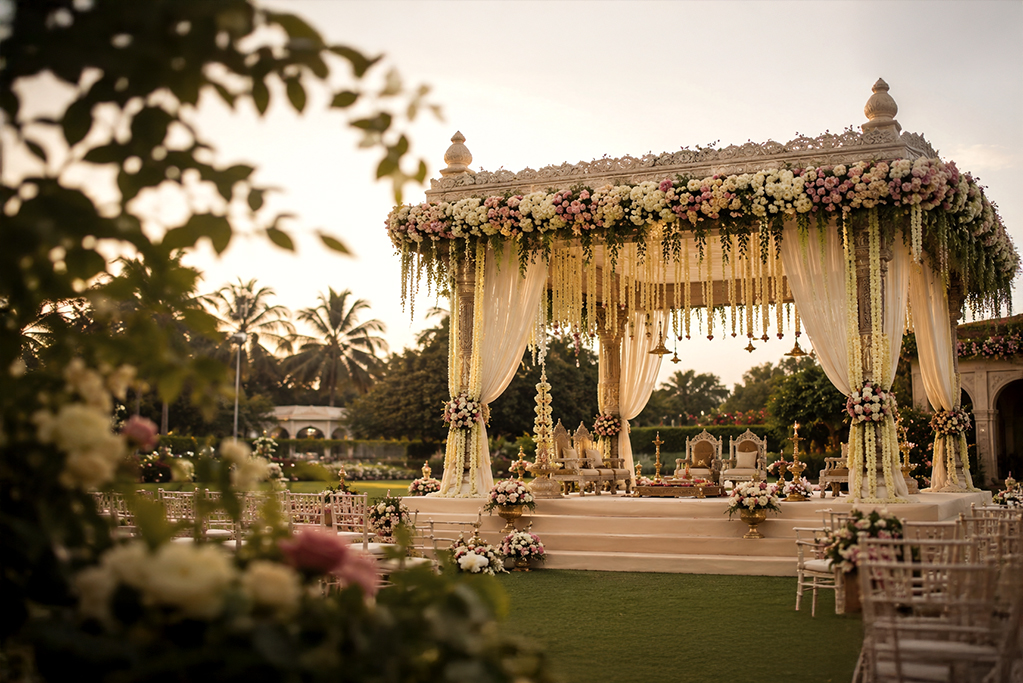
Traditional wedding decor is rooted in heritage, formality, and the kind of romance that feels like it’s been passed down through generations. It draws from cultural customs, religious ceremonies, and the collective memory of what a wedding ‘should’ look and feel like.
Walk into a traditional wedding themed decor, and you’ll notice it immediately — lush floral centrepieces bursting with roses, peonies, and marigolds; tables dressed in crisp white linen with silverware that catches the candlelight; chandeliers casting a golden glow over a room draped in satin and tulle. The colour palette leans into timeless tones — ivory, blush, deep red, and gold.
Venues tend to be grand: churches, heritage banquet halls, palace lawns, or ornate hotels. Every detail feels intentional and ceremonial, from the embossed calligraphy on the invitation to the flower girls in matching lace.
The emotional pull of traditional decor is powerful. It feels like legacy. It feels like belonging. It says: this moment matters, and we’re honouring everything that came before us.
Beautifully Now: The Contemporary Aesthetic
Contemporary wedding decor starts from a very different question — not what has always been done, but who are we?
It’s defined by individuality, artistic restraint, and a willingness to break from convention with intention. Where traditional decor fills a room, contemporary decor edits it. Where tradition layers texture and abundance, contemporary design finds beauty in the considered and the spare.
Think sculptural floral arrangements in matte ceramic vases, or a single arching branch that becomes a centrepiece through sheer confidence. Think dried pampas grass, structured proteas, and wildflowers that look as if they were gathered from a field that morning. The colour palette moves away from ivory and gold into terracotta, sage green, dusty blue, warm clay, and deep moody neutrals.
Venues are often non-traditional — an art gallery, a vineyard, a rooftop at golden hour, a restored industrial loft. Lighting becomes a design element in itself.
The emotional appeal here is intimacy and self-expression. A contemporary wedding styling feels like a portrait of the couple, specifically them.

Where the Two Styles Clash
As beautiful as both aesthetics are, blending them doesn’t come without friction. Here’s where couples most often find themselves stuck:
- Family expectations
A parent who has dreamed of a certain kind of celebration for decades may find a minimalist, contemporary setup difficult to embrace. This isn’t about taste — it’s about meaning. - Venue limitations
Some spaces simply resist certain aesthetics. A grand heritage ballroom can feel at odds with stark minimalism. Equally, a raw industrial loft may swallow delicate floral arrangements without a trace. - Budget conflicts
Traditional decor can feel expensive when done lavishly. But poorly executed contemporary decor can feel sparse rather than intentional. Both styles require investment to land well. - Vendor fit
Not all decorators, florists, or stylists work confidently across both worlds. Finding vendors who understand the vision — and can execute a blend — matters more than most couples anticipate.
None of these tensions are insurmountable. But naming them early helps you navigate them with clarity and grace.
The Case for Blending Both
The most memorable weddings we see today aren’t those that commit rigidly to one aesthetic. They’re the ones that find a harmony between heart and vision.
The key is the concept of an anchor style. Choose one aesthetic as your dominant language, and let the other play a supporting role. If your venue, your attire, and your ceremony are rooted in tradition, let your contemporary touches live in the details — the stationery, the lighting, the table settings. If your overall vision is modern and editorial, let your traditional elements carry emotional weight — the florals, the centrepieces, a nod to cultural ritual.
When one style anchors and the other accents, the result doesn’t feel conflicted. It feels layered.
A Practical Balance Guide, Element by Element
Here’s how to approach each decor decision as a blend rather than a binary:
Element | Traditional Touch | Contemporary Twist |
Florals | Full, lush, symmetrical centrepieces | Sculptural, dried accents or geometric vases |
Lighting | Chandeliers and candelabras | Edison bulbs, neon signs, geometric pendants |
Table Setting | Fine china and linen napkins | Organic ceramics and mixed metals |
Colour Palette | Ivory, blush, and gold | Terracotta, sage, or dusty blue accents |
Stationery | Embossed calligraphy | Illustrated or typographic design |
Venue Styling | Draped fabric and chandeliers | Structural installations and raw textures |
Use this table as your starting point. Pick one column as your dominant mode. Then borrow one or two elements from the other to create depth and contrast.
The Balance Is Yours to Define
There is no universally right way to decorate a wedding on a budget. There’s only the way that reflects who you are, honours what you value, and creates an atmosphere where the people you love feel the weight and joy of the moment.
Traditional decor carries legacy. Contemporary decor carries identity. And when you find the balance between them, you get something neither style could offer alone. You get a wedding that feels both timeless and entirely yours.
Planning your wedding and unsure where to start with decor? Save this post, share it with your partner, and begin the conversation. The best weddings begin with honest ones.
FAQ’s
1. Can I mix traditional and contemporary decor without it looking mismatched?
Absolutely — in fact, the most visually interesting weddings do exactly that. The key is to choose one style as your anchor and let the other play a supporting role. When there’s a clear dominant aesthetic with intentional accents from the other, the result feels curated, not conflicted.
2. How do I convince my family to embrace a more contemporary wedding vision?
Start by identifying which traditional elements carry the most meaning for them — and keep those. Then show them how contemporary touches can coexist alongside what they love. Often, resistance softens once family members see that their expectations are being honoured, not erased.
3. Is one style more expensive than the other?
Not necessarily — both can scale widely depending on choices made. Traditional decor can become costly with full floral installations and ornate table settings. Contemporary decor, when done poorly, can feel bare rather than minimal. Budget impact comes down to execution quality, not aesthetic category.
4. What if my venue strongly favours one style — do I have to match it?
Your venue sets the tone, but it doesn’t have to dictate every detail. A heritage ballroom can be softened into something more contemporary with lighting and table styling choices. A raw industrial space can be warmed with lush florals and rich fabrics. Work with the bones, not against them.
5. How do I start figuring out which style is right for us?
Build two separate mood boards — one purely traditional, one purely contemporary — without overthinking it. Then look at them side by side and notice where your eye keeps landing. The details that genuinely excite you, rather than the ones you feel you should want, are usually the honest answer.
Popular Posts

The One Stop Destination Wedding Venue in Hyderabad
Team Wedica
SEP.23, 2024

The Ultimate Destination for Your Sangeet Ceremony in Hyderabad
Team Wedica
SEP.23, 2024

The Perfect Destination for Your Mehendi Ceremony in Hyderabad
Team Wedica
SEP.23, 2024

The Ultimate Destination for Your Sangeet Ceremony in Hyderabad
Team Wedica
SEP.23, 2024
